
Ethan Taylor Scouting Deepdive: Tom Izzo's Next Big Project
Despite being a top five center in his recruiting class, Ethan Taylor played limited minutes in his senior season; will he be ready to contribute for Michigan State?

While I don’t think the 2026 recruiting class is as weak as many evaluators have pronounced it to be, I do question the class’s depth at the center position. As of today, the highest ranked center of the group is Obinna Ekezie Jr, who only recently reclassed out of his original 2027 graduating class. Before his reclass, the title belonged to Arafan Diane, a player who I was very high on before I saw his apparent weight gain during the McDonald’s All-American game (The 7’1” behemoth looked even heavier than his listed 290lbs). Neither Ekezie nor Diane are consensus five-star prospects. Because of this class-wide issue, I wanted to dig into the film of another highly touted 2026 big man in hopes of gaining confidence in the center class as a whole. Instead, I was left with even more questions. That’s not to say that all is bad regarding four-star big man Ethan Taylor, but he’ll certainly be a major developmental project for Tom Izzo and the Michigan State staff throughout his time with the program.
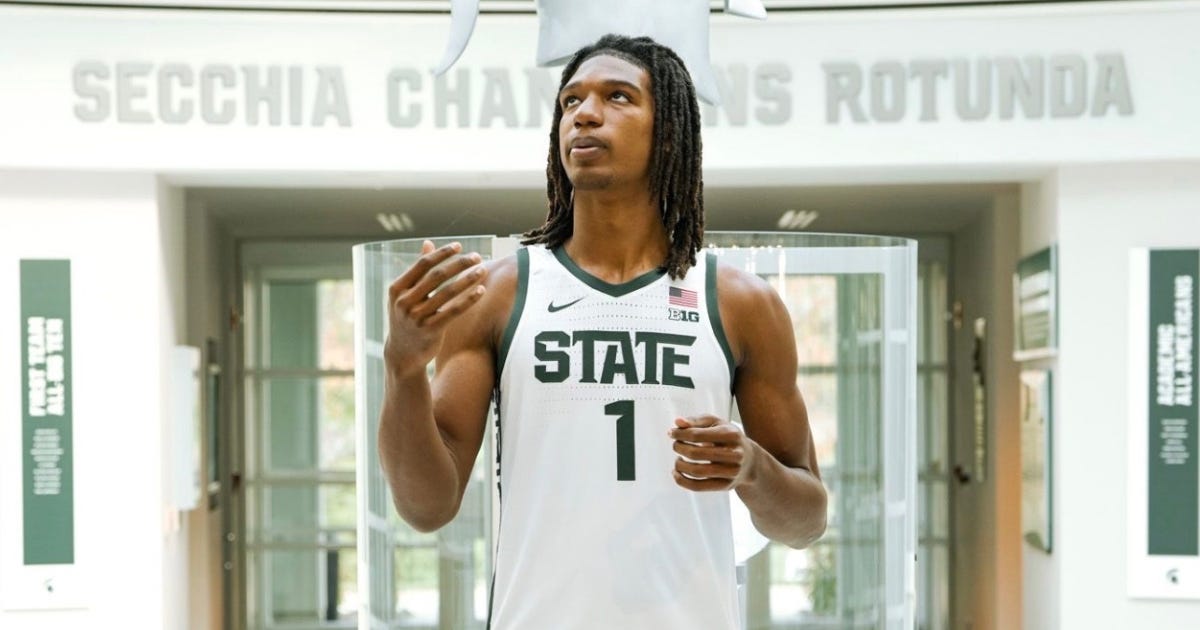
Photo Credits - via On3
Player Profile:
Ethan Taylor is a 7’1” and 245lb center originally from Shawnee, Kansas who played the first three seasons of his high school career for his hometown Shawnee Mission Northwest High School. The towering Taylor cemented himself as a high major recruit during his years with the Cougars before transferring to Link Academy for his senior campaign. Before that, he appeared alongside many of his Link teammates for Mokan Elite on the EYBL circuit. With Mokan, he posted averages of 9.4 points and 8.8 rebounds per game. He started sporadically for both Link Academy and Mokan Elite, backing up fellow 2026 big man Tristan Reed for large portions of his senior season.
Taylor committed to head coach Tom Izzo and the Michigan State Spartans in November of his senior season, choosing the program over Kansas, Kentucky, Oregon, Indiana, and Oklahoma. He joins a program known for developing big men and will likely be the backup center behind Charlotte transfer Anton Bonke. This role will suit him well as he grows accustomed to collegiate competition and develops his game, as I’m not entirely confident that he’s prepared to make a major impact in the Big Ten as of today.
Interior Scoring:
Taylor isn’t much of a scorer from any level, but when asked to score, he’s certainly at his best around the rim. On most offensive possessions he simply operates as a mobile screener and pick-and-roll decoy, but he’ll occasionally be tasked with creating his own offense down low or operating as a play finisher. I’d argue that he’s significantly better as a play finisher than he is as a creator, as he struggles with turnovers and overall ball security when he attempts to put the ball on the floor. Instead, his shot diet is safest when he’s a lob target or a dump off recipient, both instances where he isn’t required to dribble the ball.
Despite his struggles when it comes to close range self-creation, he’ll occasionally show flashes of back-down or face-up scoring under very specific conditions. He typically finds success in this department either when his primary defender overcompensates, perhaps by leaning heavily into one shoulder and allowing for the spin, or when a double-team fails to come. He is a mobile big man, so when he does get a step on his defender, he is rather proficient. As long as there isn’t another defender waiting behind the one he’s already beaten, you can usually count on him to finish the attempt. However, he struggles greatly with help defense, regularly turning the ball over either because he decides to take one too many dribbles or because he’s holding the ball below his waist where it can easily be slapped loose. The Michigan State coaching staff is going to have to work on his decision making from this level, as it is greatly lacking.
As I said, Taylor is far better when he doesn’t have to put the ball on the floor. Because he’s a 7’1” giant with long arms and a hefty frame, he’s obviously going to be a go-to lob target. Despite this, I noticed that his teammates at Link Academy were incredibly hesitant to throw him lobs. This can probably be explained by a few factors. 1.) His teammates were ball dominant players often looking for their own shot, 2.) Taylor’s hands are questionable and his timing is inconsistent, and 3.) He struggles with fighting off interior defenders, even if they’re smaller than him, who may try to disrupt the lob. Because of reasons two and three, he’s better as a traditional play finisher than he is a lob finisher. He’s simply better at catching the ball when he can use his body as a backboard than he is at catching it above his head. As far as his freshman season is concerned, pick-and-roll and dunker spot play finishing are going to be his safest scoring methods.
Mid-Range Scoring:
As of today, the mid-range means very little to Taylor, who attempted virtually no shots from this level throughout his senior season. It’s strange, too, because he does seem to have a bit of touch (this will be most evident during the passing and playmaking section of this article). Much like how his teammates were hesitant to find him near the hoop, I don’t think he was trusted to operate from this level. I assume this is because he may try to dribble the ball to find better court position, something that he has struggled with throughout his career. However, I actually do think this is an area where we may see significant positive strides from him once he reaches the college ranks.
These are the only two clips I got of him converting an attempt from the short mid-range, and I watched nearly fifteen entire games in search of film clips. That’s not to say that he attempted a ton of these shots and these are the only two he hit, no, he simply does not attempt shots from this level. I think it’s worth noting that the push shot he made was over highly touted 7-footer Arafan Diane, who was giving Taylor a ton of trouble from a physical perspective in their matchup. This is a good illustration of why developing a game from this level will be so incredibly important for Taylor, as he’s not a physical player. He gets pushed off his spots a ton, gets his arms tangled up regularly, and can get knocked out of rhythm by contact on the move. If that remains the case, he’ll have to rely on finesse shots like these rather than the brute force interior offense like you’d expect from a player with his physical profile.
Outside Shooting:
Beyond the arc offense is currently not a part of Taylor’s game, and I saw no indication that it will be anytime soon. Not only does he not attempt shots from long-range, but he’s not a particularly good free-throw shooter, and he doesn’t even attempt short mid-range shots. For all I know, he’s in practice knocking down threes like it’s nobody’s business, but he doesn’t do that in games. That said, it’s not the end of the world if he never develops an outside shot. He’s a true center with a great physical profile; it’s far more important that he strengthens his interior scoring, rebounding, and defense before he ever thinks about spending time working on his long-range marksmanship.
Passing & Playmaking:
Passing is, without a doubt, Taylor’s most intriguing long-term skill. Rim protection is probably his most important skill as of today, but his passing is the only thing he did in high school that gives me hope regarding his professional outlook. He really is a talented passer, and I’m surprised by how under discussed this is by prep evaluators and how underutilized it was throughout his senior season. For a guy who has trouble making quick decisions as a scorer, his decision making as a passer is fantastic. He also makes pinpoint passes without putting the ball on the floor, taking his turnover problems out of the equation. Finally, he’s able to operate as an offensive hub from the perimeter, where double teams are less common and where he’s less likely to be harassed by opposing defenses.
The difference in comfort from his scoring tape to his passing tape is just so evident; the guy is clearly a naturally gifted passer. His timing is excellent, and his patience is standout, as his teammates often receive the pass at the perfect moment to attempt their shot without an adequate contest being offered. Sometimes he’ll hold onto the ball for quite a while, waiting for his cutting teammate to get to the right spot, and other times the ball will pop off his hands almost immediately. While this is where he saw the most usage (or at least that’s the way it seemed considering how much more impactful his passing is than his scoring), I still think he should have been used as an offensive hub more often.
He’s also an excellent kickout passer, often throwing over-the-head laser passes across court to open shooters on the perimeter. In this compilation, I had to include a few potential assists, as his teammates were unable to convert the attempt following the pass. Again, he does this with a level of comfort that we don’t see in any other aspect of his game. His height is a huge advantage for him as a passer, as it allows him to see and throw passes over most of his primary defenders. When he’s matched up against a center who he doesn’t have as drastic of a height advantage against, he’s able to toss passes underhanded or even around their body. If he is ever able to translate his confidence into other areas of his game, he’ll see major growth. Finally, I hope to see Izzo and company utilize his passing during his Spartan tenure, as I’d hate to see this skill go to waste.
Defense:
As I mentioned earlier, rim protection is probably Taylor’s most obvious win-now trait, as his size and mobility allow him to rack up blocks despite not playing a ton of minutes. What makes him such a talented rim protector is that he’s not only a drop defender, but also a legitimate recovery defender capable of accelerating to the rim for come-from-behind blocks. He often allows smaller guards to beat him off-the-dribble on the perimeter so that he can contest their shot at the rim, decreasing his chance of picking up ill-advised fouls. He’s also willing to step away from his interior matchup to block shots from the mid-range and perimeter. All in all, you can trust him to offer strong rim protection when he’s on the floor, ensuring that he makes a positive impact even when he’s not affecting the game on offense.
I imagine that he won’t be asked to fly around the court hunting blocks at the next level, but he’s capable of performing that task. For a guy who, at times, can look very uncomfortable on the court, his ability to utilize burst as a shot blocker is a surprisingly unique skill. He’s a talented primary and help side rim protector, offering the coaching staff more lineup options if other frontcourt players aren’t as good as Taylor in this department. If he can improve his discipline (his timing can sometimes falter and he’s quick to jump at shot fakes), he could evolve into a nearly flawless rim protector. I’d say his biggest weakness is his lack of standout vertical athleticism, but he’s not totally inept in this department and his size will always make up for most athletic shortcomings as an around-the-rim defender.
One thing he doesn’t do is generate steals, which is strange considering he is willing to leave the post and defend along the perimeter. He’s a capable pick-and-roll defender, usually being able to recover to the roller even after an aggressive hedge, but that rarely results in steals for him. His hands aren’t great, and he’s not too interested in poking balls loose or keeping opponents on their toes, instead opting to try his luck at contesting their shot. His biggest weakness in this department is occasionally getting out of position, as he can get lost in the shuffle throughout an offensive possession. He’s also not very vocal on the court, something that tends to seal the deal when a player gets lost on defense. Much like his rim protection, a focus on discipline will be important moving forward.
Rebounding:
For many of the same reasons why Taylor is an underwhelming interior scorer, he’s also an underwhelming rebounder. He’s just not a physical player, leading him to play down to his competition when matched up against smaller opponents and get bullied when matched up against legitimate size. He gets pushed off his spot way too much, often leaving him out of position for rebounds on both ends of the court. That said, he’s still a 7-footer, so he’ll still luck into rebounds and occasionally put the ball back up for easy points. This gives you an idea of how effective he’ll be if he improves his physicality and starts playing with more confidence.
The film compilation above showcases a few skills that, if Taylor really focused on his offensive rebounding, would allow him to improve dramatically in this department. The first is his touch, as his feel is good enough for him to convert tip-ins even if they’re relatively far off the rim. The second is his size and strength, as he should be able to go back up for putback dunks against a lot of interior defenders. While he’s proven that he’s not a physical player, he’s a naturally strong player whose physical profile alone is a fantastic foundational asset for two-way rebounding. There’s no reason why, after a few months in a Tom Izzo system, that Taylor shouldn’t be at least an average two-way rebounder.
Summary:
Before I summarize Taylor’s game, I want to list out any and all of his weaknesses and flaws in order to garner a better understanding of his game in its entirety. I feel like I’ve been somewhat negative throughout this article, as I’ve already mentioned most of his weaknesses, but that’s only because I view him as more of a long-term project piece rather than a win-now addition. Still, I’ll include flaws that I’ve already mentioned. It’s worth noting that all players have weaknesses, but what makes the great players great is their ability to improve upon their weaknesses rather than view them as areas void of potential. Taylor, for example, has a ton of potential, but will have to majorly polish his game before he’s able to fulfill it.
His lack of physicality hinders his game in a myriad of ways, especially in areas where hefty 7-footers typically excel. He plays far smaller than he is, limiting his ability to put his promising physical traits to use on both ends of the court.
He has to stop putting the ball on the floor in an attempt to create his own offense inside. Either that or he needs to become a better decision maker in these scenarios, as he turns the ball over at an incredible rate once he starts dribbling.
He’s bad at keeping the ball high and secure, instead opting to keep it around his waist where opponents can easily slap it out of his hands. This is another example of a bad habit that occurs almost every time he gets the ball inside.
Despite showing flashes of soft touch shot making from the short mid-range, he rarely attempts hook or push shots. If he’s not going to make drastic improvements as an interior scorer, he’ll need to gain confidence from this level and increase his volume.
He has no semblance of an outside shooting game, which wouldn’t be a big deal if he were a dominant interior and mid-range scorer. However, because he’s neither of those things, his lack of a three-point shot further weakens his long-term offensive outlook.
Despite being a very talented passer, his teammates and coaching staff rarely trusted him enough to allow him to operate as a true offensive hub. This is the only offensive category where he looks comfortable and confident, so he needs to improve in other areas so that others believe in his passing ability.
While he is a talented rim protector and an all-around mobile defender, he’s a bit undisciplined and awkward on this end of the court. Again, I assume this is a comfort issue, but considering that he’s already rather effective in this area, I expect him to look more comfortable in the future.
He’s a poor rebounder for the same reasons why he’s not much of an interior scorer. He allows smaller defenders to bully him down low, getting pushed off his spot and out of position on almost every possession. Once he realizes he’s bigger than almost everyone on the court, this issue should solve itself.
To summarize Ethan Taylor’s game, you must approach the task from two different perspectives: how does he currently play, and how could he transform his game in a collegiate system? The first approach will result in a negative outlook, as Taylor is very far away from being the type of player that earns looks from NBA executives. This is a guy who wasn’t a consistent starter during his senior season despite being a fringe top 30 recruit in the country. Apart from occasional flashes as an interior scorer, his scoring game is preposterously raw. His strongest offensive trait is his passing, which, while that is a positive, is not something you typically like to hear about your 7-foot center. Defensively, he’s an effective rim protector who has room to grow as an overall defender, and he’s a bad rebounder. This brings me to the second approach. If you’re just looking at his foundation (he’s a young, mobile 7-footer with a well-built frame and athletic ability), things begin to appear more promising. Most of his weaknesses feel like mental lapses to me, besides things like three-point shooting and ball handling. I really don’t think he’s as far away from being a good player as he sometimes appears to be. That said, Tom Izzo and the Michigan State coaching staff will have a big project on their hands. For Taylor’s and the Spartans’ sake, I hope they perform to the best of their ability on that project.